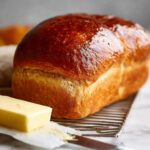
Description
Grandma Prudy’s Rye Bread is a classic, soft, and tender homemade rye bread recipe packed with rich flavors from molasses and caraway seeds. This bread features a delightful dense crumb with a perfect crust, ideal for slicing thin and enjoying with butter, jam, or even a retro spread of liver pate. It requires careful kneading and rising processes to achieve the ideal texture, and it bakes beautifully in the oven. Perfect for rye bread lovers looking for a flavorful, homemade loaf.
Ingredients
Scale
Yeast Mixture
- 1 scant tablespoon active dry yeast (about one 1/4 ounce packet yeast)
- 1 teaspoon sugar (to feed the yeast)
- 1/4 cup warm water (105-110°F)
Wet Ingredients
- 1/2 cup granulated sugar
- 2 tablespoons molasses
- 2 tablespoons shortening (butter-flavored Crisco preferred)
- 2 cups warm water (not too hot)
Dry Ingredients
- 2 teaspoons kosher salt (use less if using table salt)
- 1 tablespoon caraway seed (optional)
- 2 cups light or dark rye flour (spooned and leveled)
- 1/4 cup vital wheat gluten
- 3 to 3 1/2 cups all purpose flour (plus extra 1/2 cup flour as needed)
Additional Ingredients
- Vegetable oil or olive oil (for greasing pans and surface)
- 1/4 cup butter (for rubbing on bread after baking)
Instructions
- Activate the yeast: In a stand mixer bowl, combine 1 scant tablespoon active dry yeast with 1 teaspoon sugar and 1/4 cup warm water (105-110°F). Stir and let sit for 5 minutes until foamy and bubbly, indicating the yeast is active.
- Add wet and flavor ingredients: Once the yeast is foamy, add 1/2 cup sugar, 2 tablespoons molasses, 2 tablespoons shortening, 2 teaspoons kosher salt, and 1 tablespoon caraway seeds. Stir to combine.
- Add warm water: Add 2 cups warm water and mix using the dough hook or wooden spoon until blended.
- Add flours and gluten: Spoon and level 2 cups rye flour and add along with 1/4 cup vital wheat gluten. Mix on low speed to prevent flour poof.
- Add all-purpose flour gradually: Add 3 cups all-purpose flour one cup at a time, mixing on low speed between additions. Use no more than 3 cups initially to avoid dry bread.
- Knead the dough: Knead on medium-low speed for about 5 minutes; the dough will be sticky. Gradually add up to 1/2 cup more flour as needed while kneading a total of 7-10 minutes until the dough cleans the bowl edges but not the bottom. Alternatively, knead by hand on a lightly oiled surface for 10-12 minutes.
- Prepare bowl for rising: Grease a large bowl with 1 tablespoon vegetable oil.
- First rise: Transfer dough to the greased bowl, shape into a ball, turn to coat with oil, cover with parchment paper or greased plastic wrap, and let rise in a warm place (like a warmed oven at about 90-100°F) for 1 hour or until doubled in size.
- Punch down and second rise: Punch down the dough, reshape into a ball, coat the bowl with oil again, return dough to bowl, cover, and let rise a second time in a warm place for about 1 hour until doubled again.
- Prepare work surface and pans: Oil a work surface with about 1 tablespoon oil. Prepare four 7×4-inch pans with nonstick spray or use two 9×5 or 8×4-inch pans, coating generously to prevent sticking.
- Shape the loaves: Divide risen dough into 4 equal pieces (or 2 pieces for larger pans). Flatten each piece into a 7-inch square, fold the top inch down, roll tightly into a loaf shape, pinch edges, tuck ends under, and place seam side down in greased pans.
- Final rise: Cover pans with parchment paper or greased plastic wrap and let rise in a warm place until dough crowns and rises over the pan edges by about 1 inch, approximately 45 minutes.
- Preheat oven: Remove pans and preheat oven to 375°F. Avoid preheating with bread inside.
- Bake the bread: Bake 7×4-inch pans for 30-35 minutes or 9×5-inch pans for 40-45 minutes. Use an instant-read thermometer to check doneness; bread is done at 205°F (7×4 pans) or 208-210°F (9×5 pans). Bread should be well browned and firm on top.
- Butter and cool: Remove hot pans and place on wire racks. Immediately rub 1/4 cup butter over the tops. Carefully turn loaves out onto racks and cool them on their sides to prevent smooshing the soft bread bottom.
- Rest before slicing: Wait 30-60 minutes for the bread to cool completely before slicing to avoid crushing the tender crumb. Use a sharp serrated knife to slice with a gentle sawing motion.
- Serve & store: Serve with butter, jam, or liver pate. Store completely cooled bread in a large ziplock bag at room temperature for up to 3 days or freeze sealed for up to 3 months. Defrost partially frozen slices in the toaster or on the counter.
Notes
- Use warm water (105-110°F) to activate yeast properly; too hot will kill yeast, too cold won’t activate.
- Use kosher salt for best texture and flavor; adjust if using table salt.
- Do not substitute rye flour with whole wheat or other flours; this impacts bread flavor and texture.
- Be cautious adding too much all-purpose flour; rye dough is stickier and requires less flour than standard bread dough.
- Letting dough rise in a warm but not hot environment is critical for proper fermentation.
- Butter the top of the bread immediately after baking to keep crust soft and flavorful.
- Allow bread to cool thoroughly before slicing to preserve crumb structure.
- Freezing slices is recommended for longer storage and maintains freshness.